
What Is a Banquet (Hilton) Chair and How to Choose One: Hotel Guide
What is a Hilton banquet chair, aluminium or steel frame, how to pick upholstery and stacking? A selection and quantity-planning guide for hotels and venues.
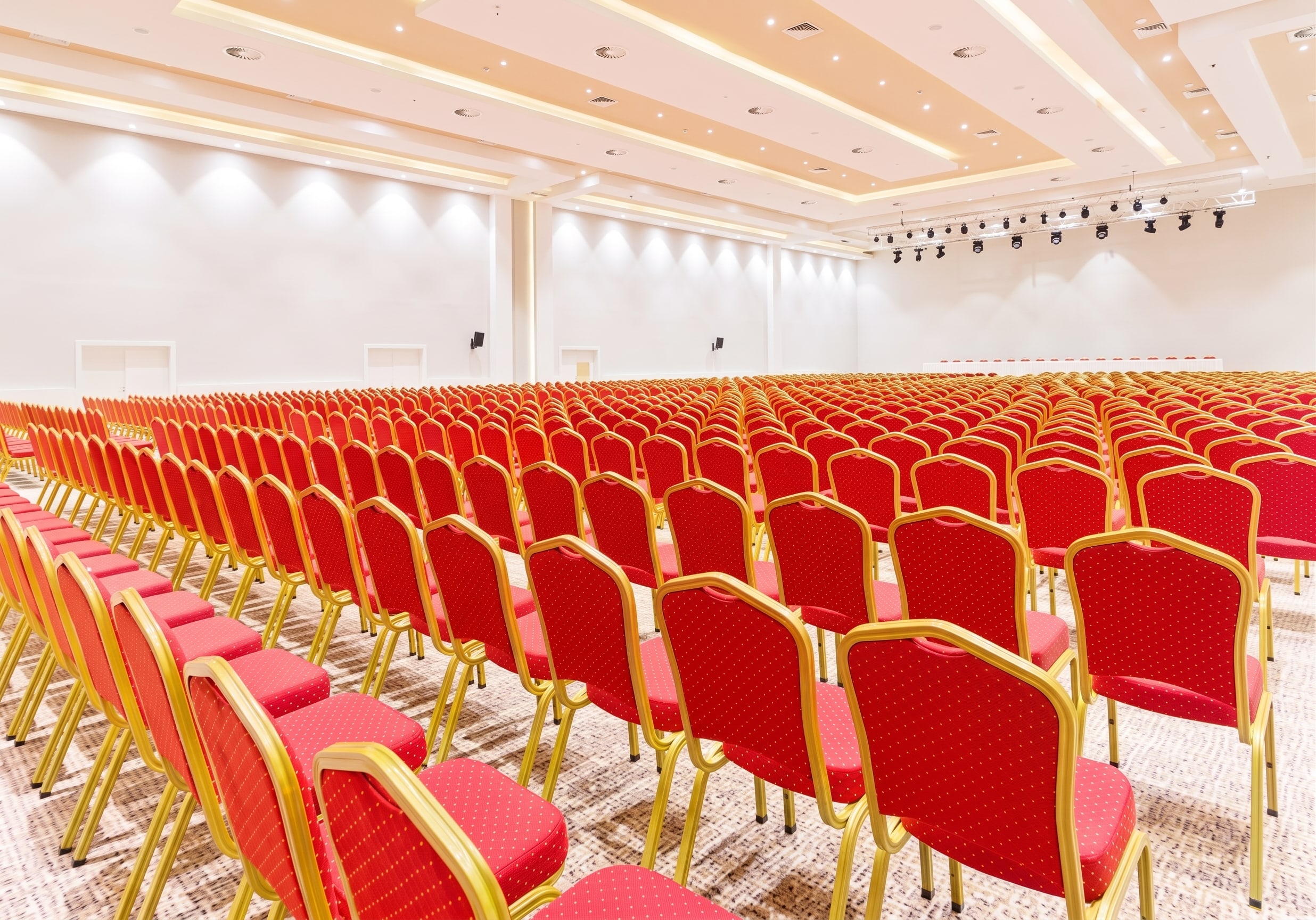
What Is a Hilton (Banquet) Chair?
A Hilton chair is an upholstered, stackable chair designed for banquet halls, hotel meeting spaces and wedding events. It got its name because it first became widespread in the ballrooms of large hotel chains; in the industry it refers to the same product as the “banquet chair”.
Three features set a standard Hilton chair apart from an ordinary dining chair:
- Stackability: 8 to 12 units can be stacked on top of one another, taking up little space in storage.
- Repeated use: It is carried, lined up and cleared away at more than one event per day; the frame and upholstery must therefore resist fatigue.
- Visual uniformity: When 200, 500 or even 1,000 units are lined up side by side, they are expected to deliver the same colour and texture.
Typical dimensions are a seat height of 45-47 cm, an overall height of 90-95 cm and a seat width of 40-43 cm. These measurements work in harmony with the standard banquet table height of 75 cm. You can review the product details on the banquet Hilton chair page.
Aluminium or Steel Frame?
The choice of frame is the most critical decision, determining both the cost and the long-term usability. There are two main options:
Aluminium frame
- Weight: A single chair weighs 3.5-4.5 kg. If staff carry hundreds of chairs a day, this difference saves their backs.
- Corrosion: Rust-proof. The only sensible choice for outdoor areas, poolsides or humid halls.
- Stacking: Thanks to its lightness, more units can be loaded onto a stacking trolley.
- Cost: Higher per unit than steel, but it lowers transport and labour costs.
Steel (iron) frame
- Weight: A single chair weighs 5.5-7 kg. Heavier, but in a fixed setup that weight gives a sense of stability against tipping.
- Durability: With correct welding and powder coating it lasts very long and tolerates impact better than aluminium.
- Cost: Generally more economical per unit.
- Risk: If the coating is scratched, rusting can begin outdoors; it is suited to indoor hall use.
A practical rule: if the chairs are moved regularly or used outdoors, choose aluminium; if they stay in a fixed indoor hall and budget is the priority, choose a steel frame. If you run a mixed venue, it makes sense to plan steel for the interior and a separate outdoor furniture group for the terrace and garden.
Upholstery and Fabric Selection
The upholstery directly affects both comfort and cleaning cost. In a banquet chair the foam density should be at least 28-32 kg/m³; a lower density collapses within a few months and ruins the seating comfort.
Three common options on the fabric side:
- Velvet/linen-look polyester: The most frequently preferred aesthetic in wedding halls; moderately stain-resistant.
- Faux leather (PU/PVC): In catered, alcohol-served events it is cleaned by wiping with a damp cloth; the most practical to maintain.
- Technical (contract) upholstery: High-turnover hotels prefer fabrics with a Martindale value of 40,000+ and a flame-retardancy certificate.
Recommending a model whose upholstery can be removed and replaced to high-use businesses gives them the option, after 3-4 years, of renewing only the fabric instead of replacing the entire chair.
Stacking and Storage Planning
Stacking is something most businesses do not factor in when purchasing but face every week. Use these figures when planning:
- A stack of 10 chairs takes up roughly 1.2-1.4 m in height; measure the ceiling height and the stacking-trolley clearance accordingly.
- 100 chairs, with stacking trolleys, fit into roughly 2-2.5 m² of storage space.
- Using a stacking trolley dramatically shortens setup time: a 500-seat hall can be laid out by two people in 30-40 minutes.
Planning chairs together with tables increases storage efficiency. Most halls position folding banquet tables next to the Hilton chairs, stored with the same stacking logic.
Quantity Planning for Hotels and Wedding Halls
The correct quantity is calculated as 10-15 percent above the hall capacity; the surplus is to cover spare, worn and under-repair chairs.
Floor area per person by layout type:
- Theatre layout (chairs only): 0.5-0.6 m² per person.
- Round table (for 10, 180 cm diameter): 10 chairs per table, 1.1-1.5 m² per person.
- U-shape meeting: 1.5-2 m² per person.
Example: about 60 percent of a 500 m² gross hall is seating area (300 m²). In a round-table layout this area seats roughly 200-250 people, i.e. 20-25 tables and 200-250 chairs. With a 15 percent surplus the order is planned at 230-290 units.
In hotels it is common for the same chair to be used interchangeably between the ballroom, meetings and the restaurant; choosing a neutral colour and model therefore makes it easier to buy more later. Sourcing the complementary hotel and banquet equipment from a single supplier also guarantees colour and batch consistency.
Pre-Purchase Checklist
When the sample arrives, or before you select a supplier, verify the following points:
- Are there burrs or coating cracks at the frame’s welding points?
- Has a 100 kg static load test and a tipping test been carried out?
- Are the upholstery density and the fabric’s Martindale value documented?
- Are floor-friendly plastic glides fitted to the feet?
- Has the stacking capacity and stacking-trolley compatibility been tested?
- Is the supply of spare parts (upholstery, glides, legs) guaranteed?
To see similar hall setups delivered previously you can review our references, and by sharing your hall’s dimensions and quantities you can quickly request pricing and samples through a quote list.